
A/B Test Referral Rewards Without Eating Your Margin
A/B test referral rewards with a control cell and single-variable design, then check the margin math before you scale the winning offer to every user.

A/B testing referral reward amounts only works if you isolate one variable, hold a true control cell, and run the test long enough to see real conversion differences. Referral reward experimentation without a margin check just finds the offer that converts best at any cost. Sometimes that cost erases the deal's profit entirely. This post walks through both halves: the test design and the math that tells you whether the winner is actually worth shipping.
What A/B testing referral rewards actually means
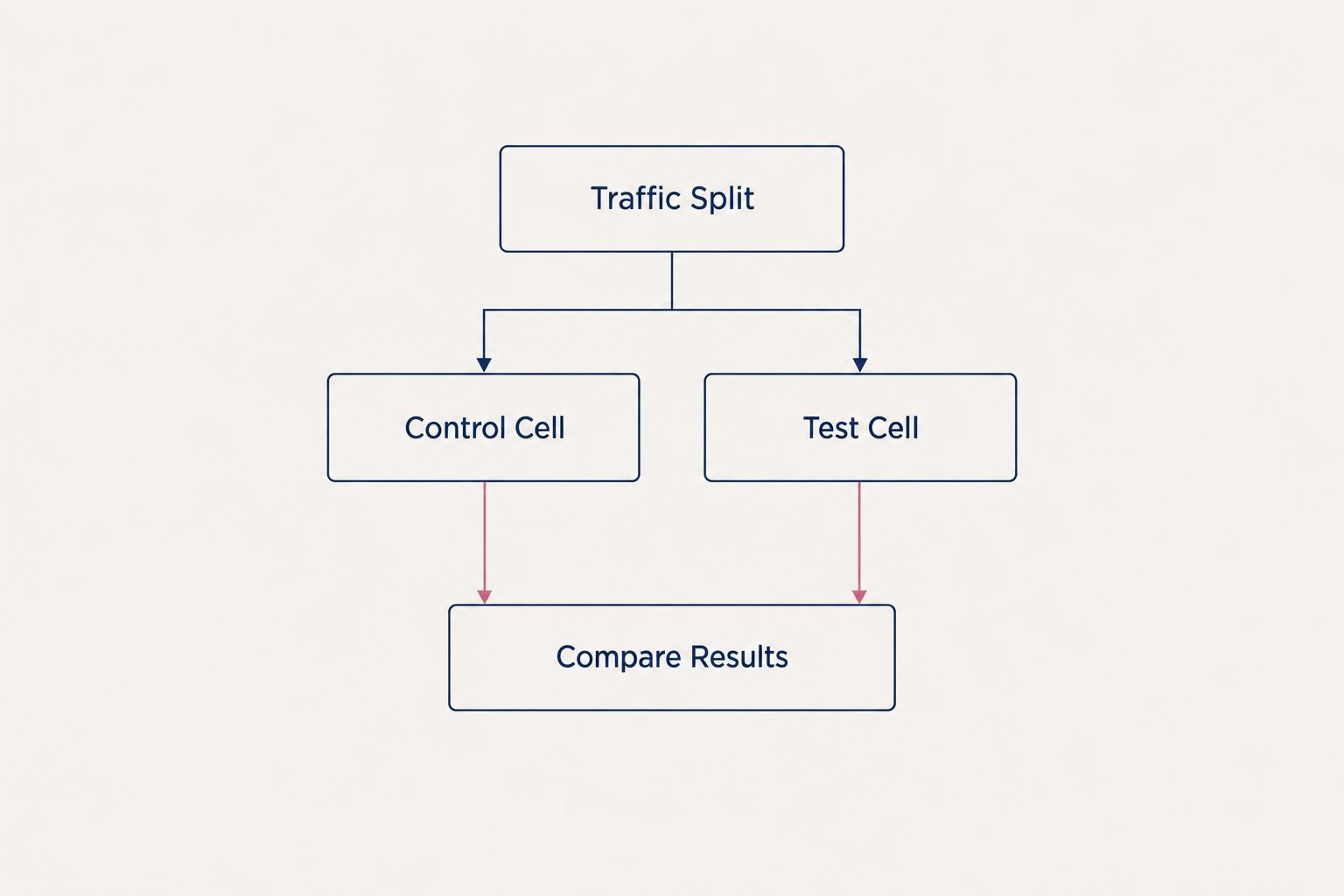
A/B testing referral rewards means running two or more reward configurations at the same time, splitting traffic randomly, and comparing conversion and payout cost per configuration before rolling one out. In ReferralFlo, this happens through built-in experimentation on reward amount, reward type, or share-moment copy. Each visitor gets bucketed into exactly one variant for the test's duration.
That definition matters. A lot of teams run something that looks like a test but isn't. They change the reward for everyone at once, then compare this month to last month. That's not a test. Seasonality, campaign timing, and traffic mix shift too much for that comparison to mean anything. A real test needs simultaneous variants, not sequential ones. No exceptions.
Set up a valid test: control cell, one variable, minimum runtime
A valid reward test needs three things: a control cell running your current reward unchanged, exactly one variable changed in the test cell, and a minimum runtime long enough to cover a full weekly cycle of traffic. Change two variables at once and you lose the ability to tell which one moved the number.
In practice that means:
- Keep a control cell live at your current reward for the full test window, not just the first few days.
- Change one dimension per test: reward amount, reward type (cash vs. store credit), or copy. Never two together.
- Let ReferralFlo's reward escrow hold the test payouts pending your existing conditions, so a variant's true cost isn't counted until the referred customer actually converts.
- Keep the trigger moment fixed. If your control fires at post-purchase, don't quietly move the test variant to checkout.
One variable. One trigger point. Everything else held constant. That's the whole discipline.
For the broader mechanics of structuring the reward itself, How to Design a Double-Sided Referral Reward That Actually Converts covers the incentive-design side. This post is about testing amounts once that structure is already set.
Worked example: margin impact at three reward sizes
Assume a DTC brand, illustrative only: $80 average order value, 40% gross margin, so $32 gross profit per order before any reward. Testing double-sided rewards of $10, $20, and $30 per side shows exactly where the reward stops adding growth and starts subtracting profit, once both referrer and referred payouts are counted against that $32.
| Reward per side | Total reward cost (both sides) | Gross profit before reward | Net margin after reward | Net margin, % of AOV |
|---|---|---|---|---|
| $10 | $20 | $32 | $12 | 15% |
| $20 | $40 | $32 | -$8 | -10% |
| $30 | $60 | $32 | -$28 | -35% |
These numbers are illustrative, built from the stated $80 AOV and 40% margin. They are not observed data. Run your own AOV and margin through the reward calculator before you set your test's reward tiers. The breakeven point moves a lot with margin and order value.
Notice the table only counts the referred customer's first order. A referred customer often keeps buying. If lifetime value clears the margin gap on a later order, a variant that looks like a loss on order one can still be the right call. That's a separate cohort/LTV question from the A/B test itself. Check it in ReferralFlo's referred-vs-paid cohort dashboards before you kill a variant on first-order math alone.
How long to run the test before you trust the result
Run each reward variant until it clears a minimum sample size calculated for the effect size worth detecting, not a fixed number of days. Evan Miller's A/B test sample size calculator shows that detecting a small lift in conversion rate needs a much larger sample than detecting a large one. A two-day test on low traffic rarely tells you anything real.
Optimizely's guide to statistical significance recommends running tests across at least one full business cycle, often two weeks. That way day-of-week and paycheck-cycle effects average out instead of skewing one variant. Referral traffic tends to be lumpier than general site traffic, since it clusters around specific triggers like renewal or post-purchase. Give it the longer end of that range, not the shorter one.
Don't peek and stop early just because one variant pulls ahead in week one. Early leads reverse constantly in small samples. Wait for the number you set at the start.
What to do with the losing reward variant
Kill the losing variant immediately, but keep its margin data. A reward that converts fewer referrals at a lower cost per acquisition can still beat a variant with a higher conversion rate. It depends how you divide total reward spend: by paying customers acquired, not by clicks or signups. Conversion rate alone is the wrong scoreboard.
Before declaring a final winner, run the surviving variant's cost per acquisition against your paid channels using the referral vs. paid CAC tool. A reward that wins the A/B test but still costs more than your blended paid CAC isn't a program improvement. It's an expensive tie. Test again with a lower amount before you scale it to every user.
Once you have a winner that clears both the conversion bar and the margin bar, document the reward rule and move it out of the experiment into your standard program config. Keep the losing variants on file. Six months from now, when margin or AOV shifts, you'll want that history instead of starting the whole test from zero.
Frequently asked questions
How many referral clicks do I need before I trust an A/B test?
Enough to clear a sample size calculated for the smallest conversion lift worth detecting, not a fixed number of days. Small expected lifts require far larger samples than large ones, so low-traffic programs need longer runtimes.
Can I test reward amount and reward type at the same time?
No. Changing both means you can't tell which change moved the result. Test one variable per experiment: amount, reward type, or copy, and keep everything else identical between the control and test cells.
What's a good minimum runtime for a referral reward test?
At least one full business cycle, commonly around two weeks, so day-of-week and payout-timing effects average out across variants rather than skewing whichever variant ran on a busier day.
How do I know if a winning reward variant is actually losing money?
Divide the variant's total reward payout by paying customers acquired, then compare that to gross profit per order. A higher-converting variant can still cost more than it returns once both sides of a double-sided reward are counted.

Referral program specialist and researcher who helps businesses turn referrals into a stable, scalable, and transparent distribution channel.
22 articles by this author →Design a reward that pays for itself.
We'll model your reward against your AOV and show the break-even in the demo.
Related reading

How to Design a Double-Sided Referral Reward That Actually Converts
A framework for double-sided referral rewards: cash vs credit vs discount, sizing incentives against AOV or AC…

Double-Sided Referral Program Statistics: 89% Pay Both
Double-sided referral program statistics: 35 verifiable live programs show 89% reward both referrer and friend…

Why referral program benchmarks go stale fast
Referral program benchmarks shift constantly, yet popular roundup posts rarely get revised: the reward terms y…