
HubSpot Referral Program Integration: No-Code Deal Triggers
Trigger referral rewards from HubSpot deal-stage changes automatically, using ReferralFlo's webhooks and reward escrow instead of a Zapier bolt-on workflow.

A HubSpot referral program integration can fire a reward the moment a deal hits Closed Won, without a single custom script. ReferralFlo listens for HubSpot deal-stage webhooks, matches the deal to a referral code, and triggers the reward rule you configured, cash, store credit, or escrowed payout, the same day the rep closes the deal.
Setting up a HubSpot referral program integration with native webhooks
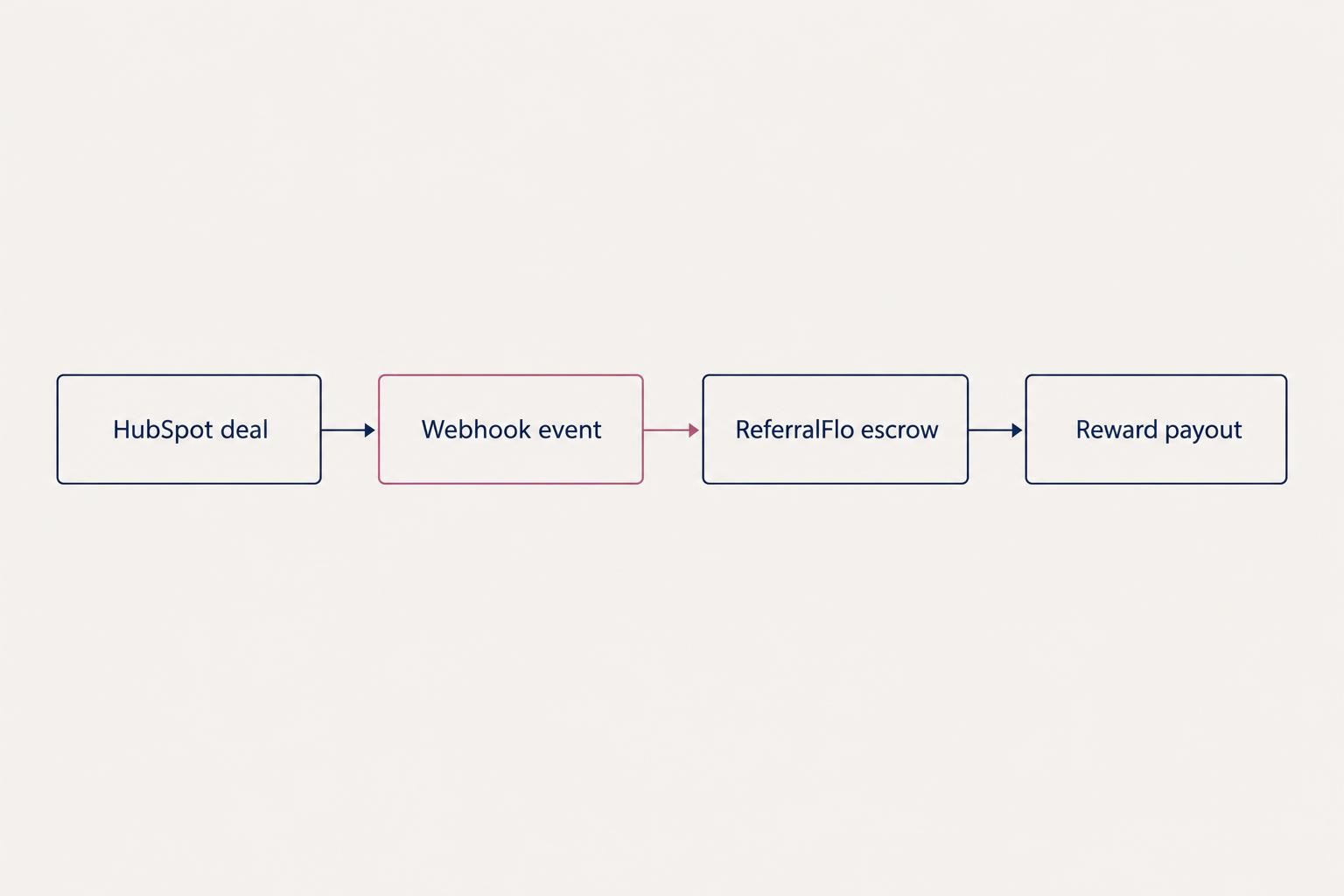
ReferralFlo's HubSpot referral program integration connects through HubSpot's native webhook subscriptions, not a middleware layer. When a deal property changes, HubSpot pushes a payload to ReferralFlo's webhook endpoint, which matches the deal's associated contact or company to a referral code stored in the Growth Graph attribution engine, then evaluates your reward rule.
The connection itself runs on OAuth, the same authorization flow HubSpot documents for its own app marketplace listings. Once authorized, ReferralFlo subscribes to a specific property change on the deal object, typically dealstage, and HubSpot's platform handles delivery. HubSpot's developer documentation on webhook subscriptions covers the payload shape and retry behavior, which matters for the duplicate-trigger handling covered below.
Referral rewards HubSpot workflow: native webhooks vs. the Zapier bolt-on
A Zapier bolt-on polls HubSpot for deal changes on a schedule, not an instant push, and routes the payload through a third intermediary before it reaches ReferralFlo. Native webhooks push the event the moment HubSpot's workflow fires, cutting the lag and removing a point of failure between the CRM and the reward engine.
Both paths work. The choice is really about where you want the failure points to live.
| Native HubSpot webhook | Zapier bolt-on | |
|---|---|---|
| Delivery | Event pushed by HubSpot's workflow engine | Trigger checked on a polling schedule |
| Moving parts | HubSpot → ReferralFlo | HubSpot → Zapier → ReferralFlo |
| Setup owner | Growth or RevOps, via OAuth | Whoever manages the Zap |
| Best fit | High-volume pipelines, revenue-critical triggers | Low-volume programs, multi-app chains |
If a deal also needs to touch Stripe for invoicing or Shopify for a storefront credit, the reconciliation logic is worth understanding on its own. Stripe-Shopify integration: reconciling referral conversions covers the pattern in more depth.
Wiring HubSpot deal stage automation step by step
Setting up HubSpot deal stage automation inside ReferralFlo takes five configuration steps: connect the HubSpot integration via OAuth, map the deal property that signals a win, create a webhook subscription for that property, define the reward rule tied to the Closed Won stage, and test the trigger against a sandbox deal before going live.
- Connect HubSpot via OAuth in ReferralFlo's integrations settings, under the same panel used for Stripe and Salesforce.
- Map the deal property that marks a win, usually
dealstage, to the specific pipeline stage ID your team calls Closed Won. - Create the webhook subscription so HubSpot notifies ReferralFlo on every change to that property, including updates well after the deal was first created.
- Define the reward rule, including whether the payout sits in escrow pending the stage change or fires immediately on match.
- Test against a sandbox deal, moving it through each stage manually to confirm the webhook fires once and the reward rule evaluates correctly.
The full field reference, including which HubSpot pipeline and stage IDs ReferralFlo expects, lives in the documentation. Most teams finish this setup in under an hour.
A worked example: escrowing the reward until Closed Won confirms
Consider a B2B SaaS company paying a $500 referral reward only after a referred deal closes. ReferralFlo's reward escrow holds the payout in a pending state the moment the referral link converts to a HubSpot deal, then releases it automatically when the deal-stage webhook reports Closed Won, cancelling escrow if the deal is marked Closed Lost.
Walk the numbers through. A prospect clicks a referral link, fills out a form, and a HubSpot deal is created at the Discovery stage. ReferralFlo logs the referral and opens a $500 escrow entry tied to that deal's HubSpot ID. Over the next six weeks the deal moves through Qualified, Proposal, and Negotiation; each stage change arrives as a webhook event, but none of them satisfy the escrow's release condition. When the deal finally moves to Closed Won, the webhook payload includes the new dealstage value, ReferralFlo matches it against the rule, and the $500 releases to the referrer's configured payout method the same day.
This is the same escrow mechanism used for KYC-gated affiliate payouts or first-order holds in double-sided reward design, applied here to a CRM stage instead of a storefront event. Teams running the program through ReferralFlo's referral management software get the escrow, approval, and audit log in one view, rather than reconciling a spreadsheet against HubSpot manually.
Handling edge cases: stage rollbacks and duplicate triggers
Deals move backward too. A rep reopens a Closed Won deal, or a refund hits after reward release. ReferralFlo's webhook listener checks the deal's current stage against the stage at escrow time before paying out, and anti-fraud detection flags duplicate webhook deliveries so a single deal never triggers two payouts.
Webhook retries are a known problem across any event-driven integration, not just HubSpot's. Stripe's own webhook documentation describes the same retry behavior, where a delivery can be sent more than once, and recommends building the receiving system to be idempotent. ReferralFlo deduplicates on the HubSpot deal ID plus the property's timestamp, so a replayed event doesn't double-release an escrowed reward. If a deal is reopened after the reward already paid, the escrow ledger flags the mismatch in the audit log instead of silently clawing back funds.
Before wiring this into a live pipeline, run the numbers on what the automation is actually worth. The ROI calculator and the referral vs. paid CAC comparison are useful for sizing whether a HubSpot-triggered program changes your blended acquisition cost enough to justify the engineering time. For teams still deciding between a native build and an agency-run affiliate setup, in-house affiliate program vs. agency covers that tradeoff from the cost side. When the pipeline is ready, book a demo to see the webhook configuration against a live HubSpot sandbox.
Frequently asked questions
Can ReferralFlo reward referrals directly from HubSpot deal stages?
Yes. ReferralFlo subscribes to HubSpot deal-stage webhooks and triggers a configured reward rule the moment a deal reaches Closed Won, with no Zapier step or custom script required.
Do I need Zapier to connect HubSpot to ReferralFlo?
No. ReferralFlo's native HubSpot integration uses OAuth and webhook subscriptions directly, though Zapier remains an option for teams who prefer a bolt-on with other apps.
What happens if a Closed Won deal gets reopened in HubSpot?
ReferralFlo checks the deal's live stage before releasing an escrowed reward, so a reopened or downgraded deal cancels the pending payout instead of paying it out incorrectly.
Which HubSpot fields does ReferralFlo need to automate rewards?
ReferralFlo needs the deal pipeline, the stage property that marks Closed Won, and the contact or company record associated with the referral code to match deals correctly.

Referral program specialist and researcher who helps businesses turn referrals into a stable, scalable, and transparent distribution channel.
30 articles by this author →Fraud checks you don't have to build.
Device fingerprinting, IP velocity limits, disposable-email blocking and reward escrow — all built in.
Related reading

Stripe Referral Integration: Gate Rewards on Payment
Stripe referral integration gates reward payouts on the invoice.paid webhook, then reverses them when Stripe i…

Stripe-Shopify Integration: Reconciling Referral Conversions
Stripe Shopify integration mismatches break referral attribution: this guide shows how to reconcile conversion…

Salesforce Referral Program Integration: A Working Recipe
Salesforce referral program integration: trigger referral tracking, stage sync, and release rewards only after…