
How to Launch a Fintech Referral Program That Clears Compliance Review
How to launch a fintech referral program that clears compliance review, using region-aware reward rules, KYC-gated payout escrow and immutable audit logs.

A fintech referral program clears compliance review when the reward logic itself enforces the rules: region-specific payout limits, KYC verification before any money moves, and a tamper-evident record of every action. The alternative is legal rewriting the mechanics after the fact. That's the difference between a six-week sign-off and a six-month one.
Why fintech referral programs get flagged in compliance review
Most referral programs get flagged because the reward structure was designed before anyone asked whether it's legal to pay it. Compliance teams at banks, lenders, and broker-dealers care about three things: who is receiving compensation, whether that person is a registered or unregistered party, and whether the payout amount or structure crosses a regulatory line for that jurisdiction.
FINRA Rule 2040 restricts member firms from paying transaction-related compensation to unregistered persons, with narrow exceptions for finder's fees under specific conditions. A referral program that pays customers cash for introducing new brokerage clients can walk straight into this rule if the payout is structured as compensation tied to a completed transaction. In the UK, the FCA Handbook's CONC 3 chapter on financial promotions and communications governs how consumer credit firms can describe and pay for referrals, including disclosure obligations when a reward is contingent on the referred person taking out credit. Germany is different again: BaFin operates a notification regime for tied agents (gebundene Agenten) that can apply to referral partners depending on how the arrangement is structured. Check the current BaFin guidance directly; the tied-agent rules are revised periodically.
The fix isn't avoiding referral programs. It's building the constraints into the reward engine so the program can't accidentally violate them.
Region-aware reward rules: matching payouts to the referred user's jurisdiction
Region-aware reward rules tie the type, amount, and timing of a referral reward to the regulatory jurisdiction of the person receiving it. A program can pay a US customer in cash while paying a UK customer in credit, or withhold a payout entirely where local rules require it. ReferralFlo supports this natively, with reward rules referenced against FINRA, FCA, and BaFin constraints.
This matters because a single reward structure rarely clears review across three jurisdictions at once. A flat $50 cash reward for a referred brokerage account opening might be fine in one market and a compensation-to-unregistered-person problem in another. The table below is illustrative. It shows the kind of constraint each regulator's published guidance raises, not a claim about what any specific program must do (consult counsel for your own structure):
| Regulator | Governing document | Constraint that affects referral rewards |
|---|---|---|
| FINRA (US) | Rule 2040 | Restricts transaction-based compensation to unregistered persons |
| FCA (UK) | CONC 3, FCA Handbook | Disclosure and fairness requirements for consumer credit financial promotions |
| BaFin (Germany) | Gebundene Agenten (tied agent) notification regime | Notification requirement before appointing referral/introducer agents |
Because the reward rule is configured per region, not hardcoded once, a growth team can launch a compliant structure for the US and UK simultaneously without waiting for a single global reward policy that satisfies every regulator's strictest reading.
KYC-gated escrow: don't release the reward until the referred user is verified
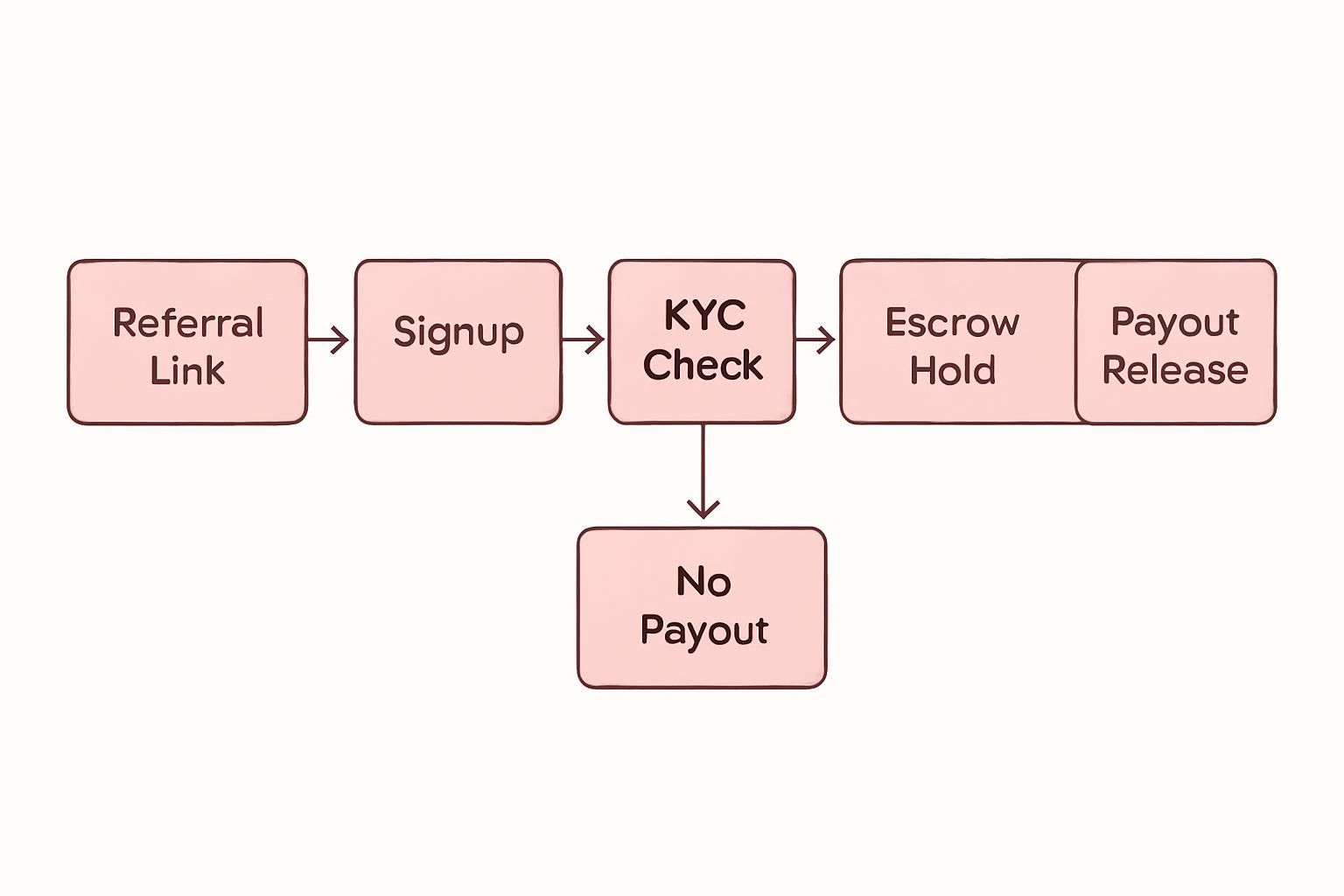
KYC-gated escrow holds a referral reward in a pending state until the referred user clears identity verification, closes an account, or completes whatever condition compliance defines. No payout ever reaches an unverified or fraudulent account. ReferralFlo's reward escrow supports holding payouts pending conditions like KYC completion, a closed deal, or a first funded transaction.
This solves two problems at once. First, it stops payouts to accounts that never complete verification, which matters for fraud control and for the FINRA Rule 2040 question of who is being compensated and for what. Second, it gives compliance a concrete gate to point to in review: the reward doesn't exist as a liability until the condition is met. There is no scenario where the program has paid a reward to an account that later fails KYC or gets flagged for a disposable email or IP collision. Pairing escrow with ReferralFlo's anti-fraud detection — self-referral, IP velocity, and device-overlap flags — closes the loop between "who gets paid" and "who was verified as a real, distinct person." For the fraud side specifically, the anti-fraud checklist for referral programs walks through the detection signals in more depth.
Immutable audit logs: giving legal a record they can sign off on
An immutable audit log is a cryptographically signed, append-only record of every referral event: click, signup, KYC pass/fail, escrow hold, payout release. Nothing can be altered after the fact, which gives compliance a verifiable trail for regulatory inquiries or internal audits. ReferralFlo generates these logs automatically for every program event, alongside PII redaction that hashes, tokenizes, or strips sensitive fields before they're stored.
This is often the single item that unblocks sign-off. Compliance and legal teams at regulated fintechs don't need to be convinced the program is fraud-resistant in theory. They need a record they can pull during an exam that shows exactly when a reward was earned, what condition released it, and that nothing was edited retroactively. An immutable log answers "can you prove this" without a bespoke reporting build for every review cycle.
A launch checklist archetype: how an early-stage fintech gets to sign-off
Consider an early-stage fintech launching a customer referral program for its lending product, needing sign-off from both legal and its head of compliance before going live in the US and UK. The path from draft to launch generally follows a fixed sequence, not a series of one-off legal memos.
- Map program to regulator constraints per region. Before configuring anything, identify which rules apply: FINRA Rule 2040 if any referred relationship touches brokerage or transaction-based compensation, FCA CONC 3 if the product is consumer credit in the UK.
- Configure region-aware reward rules to match. Set reward type (cash, credit, or donation) and payout timing per region so no single global reward structure has to satisfy every jurisdiction's strictest rule.
- Gate every payout behind KYC-conditioned escrow. No reward releases before the referred account clears verification, closes the relevant account action, or meets whatever condition compliance specifies.
- Turn on anti-fraud detection. Self-referral, IP velocity, and device-overlap checks reduce the number of edge cases legal has to reason about manually.
- Confirm the audit log covers every state transition. Compliance should be able to reconstruct any referral's full lifecycle, click to payout, from the signed log alone.
- Review with legal against the mapped constraints, not from scratch. Because the reward rules were built against the regulator documents up front, review becomes a verification pass instead of a redesign.
Teams evaluating platforms for this kind of launch can see how the pieces fit together on the fintech industry page, check the full integration list on /integrations, or book a walkthrough to see region-aware rules, escrow, and audit logging configured for a specific jurisdiction mix. For teams still scoping reward structure before compliance gets involved, the guide to double-sided reward design is a useful starting point, and the ROI calculator helps model payout cost against escrow-held liability before launch.
Frequently asked questions
Does a referral program count as a financial promotion under FCA rules?
It can, depending on how the reward is described and whether it's contingent on the referred person taking out a regulated product. FCA's CONC 3 chapter governs consumer credit financial promotions, so referral messaging and disclosure need review against that chapter specifically.
Why does escrow matter more than fraud detection alone for a fintech referral program?
Fraud detection flags suspicious activity after it happens; escrow prevents payout before the underlying condition (KYC verification, account closure, first funded transaction) is met. Combining both means a flagged account never receives a reward in the first place.
Do region-aware reward rules mean running separate referral programs per country?
No. It means one program with reward logic that branches by the referred user's region. ReferralFlo applies different reward types, amounts, or holds per jurisdiction within a single program configuration.

Referral program specialist and researcher who helps businesses turn referrals into a stable, scalable, and transparent distribution channel.
17 articles by this author →Ready to put this to work?
Watch a real program run — rewards, fraud checks and payouts — in 30 minutes.
Related reading

A Practical Anti-Fraud Checklist for Referral Programs
A referral fraud prevention checklist for engineers: self-referral detection, IP velocity limits, disposable e…

How to Launch an Employee Referral Program: A Step-by-Step Playbook
An employee referral program launch playbook: HR and Finance sign-off, reward structure, internal share widget…

Affiliate Program Launch Checklist: Tiers, Onboarding, Kits
An affiliate program launch checklist: commission tier structure, an onboarding sequence affiliates finish, a …