
Structuring Ambassador Tiers Advocates Actually Want to Climb
How to design ambassador program tiers around status, access and community, not bare point thresholds, so advocates have a real reason to keep climbing.

Structuring Ambassador Tiers Advocates Actually Want to Climb
A tiered ambassador program works when the tiers signal status, access, and belonging, not when they're point totals with a bigger discount attached at the top. Advocates climb because a label carries real recognition and closer proximity to the brand. A progress bar alone won't do it. Get the identity layer right first; reward math is a downstream decision.
Why "climb for climbing's sake" doesn't work
A tier ladder built only on point thresholds gives an advocate a reason to hit a number, not a reason to keep advocating once they've hit it. Programs that stall at the middle tier usually solved the math (payout curves, streak bonuses, point multipliers) and skipped the harder question: what does holding the "Gold" label mean to the person wearing it?
This is a motivation problem before it's a mechanics problem. Self-determination theory, the framework developed by psychologists Edward Deci and Richard Ryan, argues that sustained motivation depends on three conditions: autonomy, competence, and relatedness (selfdeterminationtheory.org). A points-only tier ladder can hit competence; you clearly did the thing. It does nothing for relatedness (do other advocates and the brand see you differently now?) or autonomy (do you have any real say in how you advocate?). That gap is why plenty of ambassador programs watch advocates hit the top tier and go quiet.
This piece is about the identity and structure question: who your ambassadors are, how they're recruited and onboarded, and what keeps them around. Payout amounts and reward curves per tier are a separate decision, covered in our breakdown of double-sided reward design.
What makes advocates want to level up
Advocates level up for recognition among peers, closer access to the people who build the product, and a sense that their advocacy is seen and valued. The next discount code is not on that list. Design the ladder around these three levers before you touch reward amounts, and retention at the top tier stops being a mystery.
Status among peers matters because recommendations carry weight precisely when they come from someone with credibility. Edelman's Trust Barometer research has repeatedly found that people trust recommendations from peers more than branded content, which is the entire premise an ambassador program monetizes (Edelman Trust Barometer). If a top-tier ambassador's status is invisible to the community they're supposedly leading, the program isn't using the trust it's built on.
Access is the second lever: early product access, a direct feedback channel to product or marketing, invitations to closed events or roadmap previews. None of this needs to be expensive. It needs to be scarce and genuinely tied to the tier. Community is the third: a private channel, a named cohort, visibility to each other. Ambassadors who know who else made it to their tier behave differently than ambassadors who only see their own dashboard.
Designing the tier ladder around identity, not thresholds
Each tier should change three things for the advocate: what they're called and how visible that is, what they get access to, and what role they play in the community. The point threshold to reach it is the least important column, not the headline. Below is a structure built around identity markers instead of reward size.
| Tier | Identity marker | Access granted | Community role |
|---|---|---|---|
| Applicant | Not yet an ambassador | Standard referral link | None |
| Advocate | Verified member, visible badge on shared links | Early access to feature announcements | Listed in community directory |
| Partner | Named in program communications | Direct feedback channel to product/marketing | Invited to quarterly advocate calls |
| Council | By invitation only, capped cohort size | Roadmap preview, co-marketing opportunities | Mentors newer advocates, weighs in on program changes |
Getting from one row to the next still requires some threshold — referrals converted, activations driven — but that number is the gate, not the reward. ReferralFlo's ambassador program type is built for exactly this kind of tiered advocate community. The Growth Graph attribution engine tracks referral activity across each advocate's shared links so tier movement reflects real conversions, not raw clicks, and ML-based anti-fraud detection catches self-referrals or device overlaps so a status like "Council" stays earned. See how the tiering, attribution, and fraud checks fit together on the product overview and in the ambassador platform.
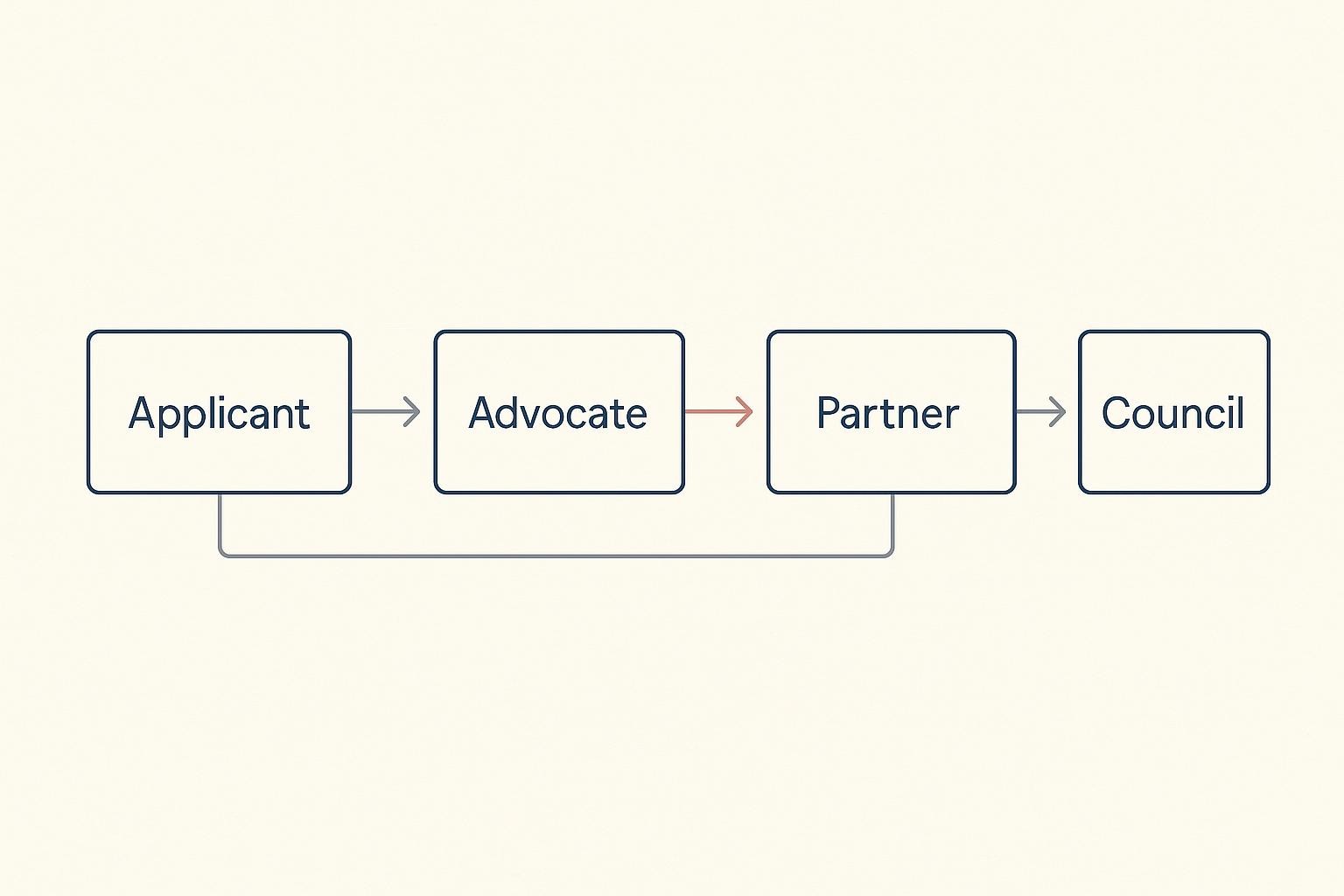
A capped top tier matters more than it looks. If everyone eventually reaches "Council," the label stops carrying information and the community layer collapses back into a points ladder with better copywriting.
Recruiting, onboarding, and keeping ambassadors engaged over time
A tiered program lives or dies on the entry and retention loops around it: who gets invited into the first tier, how they're onboarded into the community's norms, and what keeps a top-tier advocate from going quiet six months in. Automating tier-change events into your CRM is what makes the identity layer operational instead of aspirational.
Recruiting into the entry tier works better as an application or vetting step than an open signup form. It's the first identity signal, and it filters for advocates who want the status more than the discount. Onboarding should orient new advocates to what the community looks like at each tier above them, not just how the referral link works. The in-product share widgets can trigger a welcome flow the moment someone joins, and webhooks paired with the TypeScript/JS SDK can push a tier-change event into Salesforce or HubSpot so a real person on your team follows up when an advocate is promoted, instead of a generic email firing automatically. Full setup details for wiring tier events into your CRM live in the integrations hub and documentation.
Retention at the top tier is the part most programs underbuild. A capped Council tier needs rotating opportunities — a new roadmap preview, a fresh co-marketing slot — or it turns into a static list of names nobody revisits. It also needs an honest sunset path: advocates who go inactive should move down or out, because a tier that never contracts stops signaling anything. If your current program is stalling before it gets this far, the diagnostic in why your referral program isn't growing is a useful place to check for structural gaps before you touch tier design.
Model the economics of an ambassador cohort (cost per tier, expected referral volume) with the ROI calculator, and generate the trackable links each tier needs with the link generator. To see tiering, attribution, and CRM sync running together, book a walkthrough.
Frequently asked questions
How many tiers should an ambassador program have?
Three or four. That's enough to create meaningful identity distinctions without diluting what each label means; more than that and the tiers blur together and lose their signaling value.
Should the top ambassador tier be capped?
Yes. An uncapped top tier eventually includes everyone who stuck around, removing the status signal that made it worth reaching. Capping it, even loosely, keeps it meaningful.

Referral program specialist and researcher who helps businesses turn referrals into a stable, scalable, and transparent distribution channel.
23 articles by this author →Design a reward that pays for itself.
We'll model your reward against your AOV and show the break-even in the demo.
Related reading

Why Your Referral Program Isn't Growing (And How to Fix It)
Why your referral program isn't growing: five failure modes, from a buried share moment to unchecked fraud, wi…

In-house affiliate program vs. agency: cost and control
An in-house affiliate program typically costs less per dollar of sales once volume grows, but an affiliate age…

The Thank You Note for a Referral That Earns a Second One
A thank you note for a referral only works when timing, channel, and wording make the referrer feel genuinely …