
Where to Place Your In-Product Share Moment for Maximum Conversion
Where to trigger in-product referral widgets: signup, activation, upgrade, renewal or post-purchase, plus A/B testing tactics and React embed patterns.

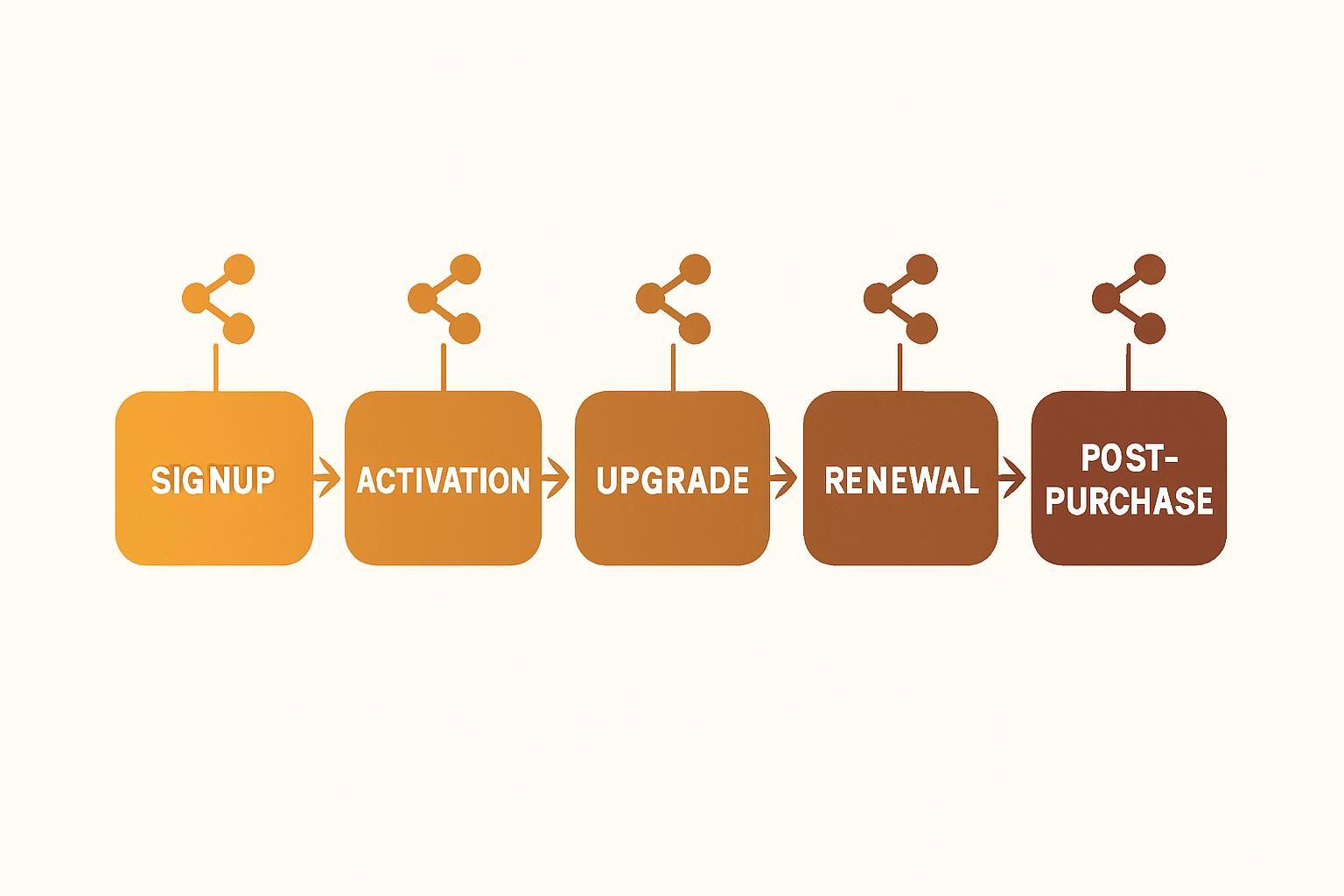
Share moment placement determines whether a referral program gets used or ignored. The highest-converting placements are activation and post-purchase, because both coincide with a spike in customer satisfaction. That's the exact window where someone is most willing to vouch for you. Signup and renewal placements convert lower but reach a wider audience.
What is an in-product share moment?
An in-product share moment is a referral widget or share flow embedded directly inside your product or storefront, triggered by a specific user event instead of sent via a separate email or dashboard tab. ReferralFlo supports this through an embeddable React widget or iframe embed, plus Shopify theme blocks for storefronts, so the ask appears at the moment intent is highest.
Placement matters more than copy or reward size because a referral ask competes with whatever the user is trying to accomplish. Interrupt a frustrated user mid-task and the ask reads as friction, regardless of incentive. Surface the identical widget one screen after a win — an order confirmed, a workflow completed, a plan upgraded — and it reads as a natural next step. Same copy, same reward, opposite reception. This is a UX sequencing problem, not a copywriting problem.
Comparing the five core trigger points
Each trigger point sits at a different emotional and behavioral stage of the customer lifecycle, and each has a distinct mechanism for why it converts the way it does. The table below breaks down the reasoning behind each placement: the user state it depends on and the failure mode it carries. Treat it as a framework for choosing where to test first, not as a prediction of what your own numbers will be.
| Trigger point | User state | Why it converts | Best reward structure |
|---|---|---|---|
| Signup | Curious, unproven | Low commitment, high reach, low emotional buy-in | Double-sided credit to reduce risk perception |
| Activation | Just hit first value (setup done, first order placed) | Peak satisfaction before habit forms | Immediate reward or reward escrow released post-activation |
| Upgrade | Just paid more, reaffirming decision | Sunk-cost confidence, self-justification | Tiered reward matching new plan value |
| Renewal | Committed long-term, low churn risk | Trust has compounded over the contract | Loyalty currency or account credit |
| Post-purchase | Fresh dopamine from a completed transaction | Immediate satisfaction, product top-of-mind | Discount code or store credit on next order |
Activation and post-purchase consistently outperform signup-stage asks because the user has already received value. They're not speculating about your product; they're confirming it. Renewal-stage asks convert on trust more than excitement, so pairing them with loyalty currency instead of one-time cash tends to fit the emotional register better.
For SaaS teams, activation is usually the single highest-leverage placement: right after onboarding completion or first meaningful action inside the product. For DTC and e-commerce brands, post-purchase (on the order confirmation screen, or triggered after delivery) does the heaviest lifting because it lines up with the moment a customer is most confident in their decision. Explore the customer referral program page for placement patterns specific to your program type.
Implementing the widget: React, iframe, and Shopify theme blocks
How you embed the widget affects load time, styling flexibility, and how cleanly it attaches to a specific event. ReferralFlo ships three implementation paths: a React widget for teams that want full styling control inside their own component tree, an iframe embed for faster integration with less engineering lift, and Shopify theme blocks for storefronts that need the share moment inside checkout or account pages without custom code.
The React widget is the right choice when the share moment needs to feel native: inline inside a dashboard, a settings page, or an in-app modal that respects your existing design system. It hooks into your app's own event triggers directly, so you can fire it on activation (e.g., after a webhook confirms a Stripe subscription upgrade) or on renewal (tied to a HubSpot or Salesforce lifecycle stage change).
The iframe embed trades some styling flexibility for speed of implementation. It suits teams that want a working share moment live within days, not sprint-planned into a roadmap. Shopify stores get theme blocks that drop into the post-purchase or thank-you page without backend work, which matters most for the post-purchase trigger since that's the DTC placement with the shortest window to capture attention.
Regardless of embed method, every share moment generates links through the same trackable referral link generator, which carries device fingerprinting, UTM passthrough, and cross-domain attribution back through the Growth Graph. A share triggered at activation and one triggered at renewal both attribute conversions correctly, even across connected systems like Stripe, Shopify, or HubSpot.
Testing placement instead of guessing at it
The fastest way to find your best-converting trigger point is to run structured A/B tests instead of leaning on industry benchmarks. ReferralFlo's built-in experimentation tools let you test reward type, copy, and placement simultaneously, so you can isolate whether a drop in conversion comes from a weak reward or a poorly timed trigger.
A practical test sequence: launch the same widget at two trigger points (say, activation vs. day-7 post-purchase) with identical copy and reward, and hold the variable constant for at least one full attribution cycle so cohort data isn't skewed by short sample windows. Because rewards can be held in escrow pending conditions like a completed first order or KYC step, you can test placement without prematurely paying out on referrals that don't convert.
Watch cohort and LTV comparisons between referred and paid-acquisition users, not raw share-widget click-through alone. A placement that generates more shares but lower-quality referred customers isn't winning. Real-time analytics dashboards surface referral revenue by trigger point, so you can retire underperforming placements without waiting for a quarterly review.
Before rolling a new placement to 100% of users, run the numbers through the ROI calculator to estimate payback against your current CAC, and check supported integrations to confirm the event source you want to trigger on (Stripe subscription events, Shopify order webhooks, HubSpot lifecycle stages) is already connected. If you're mapping this out for the first time, a personalized walkthrough is the fastest way to see trigger configuration against your actual event data.
Frequently asked questions
What is the best trigger point for a SaaS referral widget?
Activation, right after a user completes onboarding or hits first meaningful value, tends to convert highest for SaaS. It captures satisfaction before the ask competes with an unrelated task.
Should I use a React widget or an iframe embed for my share moment?
Use the React widget when you need native styling control inside your existing app; use the iframe embed when speed of implementation matters more than pixel-perfect styling.
Can I test multiple trigger points at once?
Yes. Built-in A/B testing lets you test placement, reward type, and copy in parallel, with cohort and LTV data to compare referral quality by trigger point.

Referral program specialist and researcher who helps businesses turn referrals into a stable, scalable, and transparent distribution channel.
17 articles by this author →Put the share moment where it converts.
Drop-in React widget, iframe embed, or Shopify theme block. Live in an afternoon.
Related reading

What to write in a referral text message
Referral text message examples for signup, renewal, and post-purchase moments, plus SMS length, timing, and pe…

The referral email template that gets opened and clicked
A referral email template that covers subject lines, send timing tied to lifecycle triggers, one clear ask, an…