
Calculating Referral Revenue Finance Will Trust
A worked formula for referral revenue: sourced vs influenced, how first-touch and last-touch attribution change the number, and how to make it auditable.

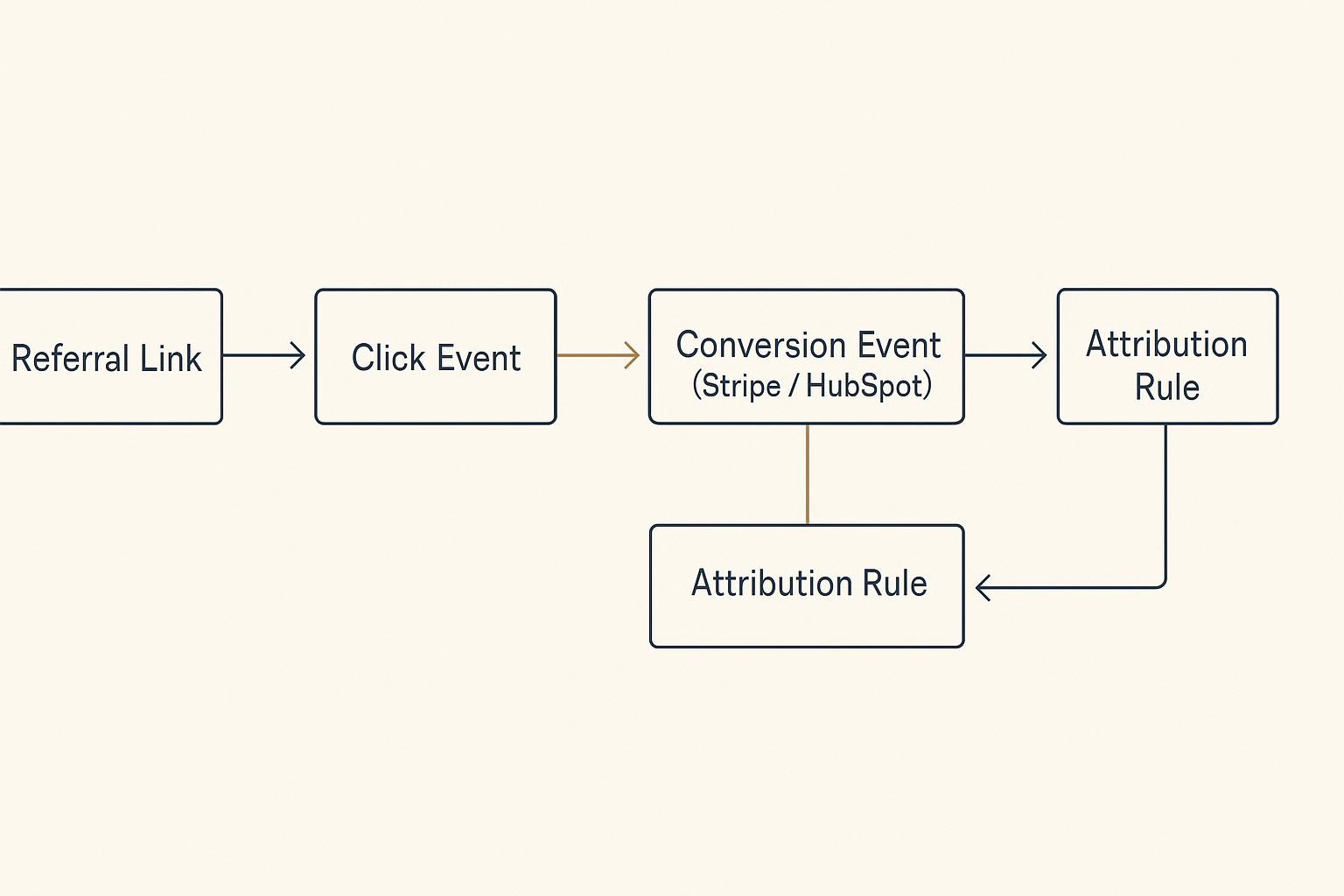
Referral revenue is the dollar value of orders or closed deals whose tracked touchpoint was a referral link. To calculate it you need a referral event, a conversion event tied to it by a persistent identifier, and an attribution rule for multi-touch buyers. Finance accepts the number only when each input traces to a system of record.
Referral-sourced vs. referral-influenced revenue: the formula
Referral-sourced revenue is the sum of order values where a referral link was the attributed touchpoint at conversion. Referral-influenced revenue is the sum of order values where a referral link appeared anywhere in the buyer's tracked journey, even without final credit. Finance usually wants sourced revenue; growth teams usually want influenced revenue for pipeline credit.
The formula for sourced revenue is straightforward once the attribution rule is fixed:
Referral-sourced revenue = Σ (order value) for every conversion where referral_id = attributed_touch
Influenced revenue widens the filter:
Referral-influenced revenue = Σ (order value) for every conversion where referral_id appears anywhere in touchpoint history
| Metric | Definition | Typical use | Risk if misused |
|---|---|---|---|
| Referral-sourced revenue | Order value where referral got final attribution credit | CFO-facing reporting, program ROI | None if attribution rule is disclosed |
| Referral-influenced revenue | Order value where referral appeared anywhere in the journey | Internal pipeline discussions, channel mix analysis | Overstates the channel if presented as "sourced" to finance |
The two numbers can differ substantially on the same order set, and the gap between them is exactly what finance will ask you to explain first.
First-touch vs. last-touch attribution: why the model changes the number
First-touch attribution credits the referral link if it was the buyer's earliest tracked interaction, regardless of what happened after. Last-touch credits whichever channel touched the buyer immediately before conversion. Neither model is "correct." They answer different questions, and picking one changes referral-sourced revenue by the full order value on any deal with a mixed journey.
Here's a worked example, using illustrative numbers only. A buyer clicks a referral link on day 1, clicks a retargeting ad on day 10, and converts on day 12 for a $1,200 order.
| Attribution model | Referral credit | Paid-channel credit |
|---|---|---|
| First-touch | $1,200 (100%) | $0 |
| Last-touch | $0 | $1,200 (100%) |
| Linear (two touches) | $600 (50%) | $600 (50%) |
Run the same cohort under all three models and the reported referral-sourced revenue can swing from $0 to the full order value with no change in what happened, only in which rule you applied. This is why the attribution model has to be stated in the same sentence as the number, not buried in a footnote. Programs with longer sales cycles (B2B/SaaS in particular) tend to default to first-touch for the same reason: it credits the channel that opened the deal, not whichever touch happened to be last before the buyer signed. For a deeper look at how attribution choices interact with reward timing, see tying payouts to completed installs, which walks through a related problem: crediting revenue only after a condition is met.
How the Growth Graph makes the number auditable, not estimated
A referral revenue number is auditable when every dollar in it can be traced back to a specific referral link, a specific conversion event, and a timestamped rule for how credit was assigned. Not reconstructed from a spreadsheet after the fact. ReferralFlo's Growth Graph attribution engine builds that chain automatically.
Each referral link carries device fingerprinting and UTM passthrough, so a click on one domain can be matched to a signup or purchase on another (cross-domain attribution) without relying on cookies alone. When a conversion event fires in a connected system — a Stripe charge, a HubSpot deal-closed stage, a Shopify order — the Growth Graph ties it back to the originating referral_id via webhook, not a manual export. Stripe's own webhook documentation describes the same event-driven pattern most finance and RevOps teams already trust for revenue recognition, which is the mechanism ReferralFlo uses to pull conversion events in near real time instead of on a batch delay.
Every attribution decision (which touch got credit, under which model, at what timestamp) is written to an immutable, cryptographically signed audit log. That log is what you hand to finance instead of a screenshot of a dashboard. You can generate the trackable links themselves with the referral link generator, and see which systems the Growth Graph can pull conversion events from on the integrations page.
Defending the number when finance asks where it came from
Finance will ask three things: what attribution model was used, whether the number reconciles against the actual payment ledger, and whether referred customers behave differently enough to justify the channel spend. Answer all three with source data, not summary metrics, and the conversation moves from "prove it" to "how do we scale it."
Start with reconciliation: referral-sourced revenue should tie back to a subset of rows in the Stripe or HubSpot export finance already trusts, filtered by referral_id, not a separately maintained total. If the two don't match, the attribution rule or the event mapping is wrong. Fix that before presenting anything.
Next, separate the ROI question from the attribution question. Run referral spend (rewards paid plus platform cost) against referral-sourced revenue using the ROI calculator, and compare payback against paid acquisition with the referral-vs-paid CAC tool. Academic research on this comparison is worth citing directly: Schmitt, Skiera, and Van den Bulte's study in the Journal of Marketing, "Referral Programs and Customer Value," found that customers referred by the program had higher value and retention than customers acquired through other marketing channels in the telecom dataset they studied. That's a useful precedent when finance asks whether referred revenue is "real" revenue or just relabeled organic growth.
Finally, be explicit about the attribution model you're using in every report, the same way HubSpot recommends stating the model choice (first-touch, last-touch, or linear) in its own attribution reporting documentation, and don't switch models between reporting periods without flagging it. A consistent, disclosed model that understates the channel slightly is more defensible than a favorable model finance later discovers you changed. If you're setting this up for the first time, the pricing page outlines which plan tiers include the Growth Graph's cross-domain attribution, and a demo is the fastest way to see the audit log output before you commit to a reporting format.
Frequently asked questions
What is the difference between referral-sourced and referral-influenced revenue?
Sourced revenue counts orders where the referral link got final attribution credit; influenced revenue counts orders where a referral appeared anywhere in the buyer's journey. Finance usually wants sourced.
Why does the attribution model change the referral revenue number?
First-touch and last-touch can assign the full order value to different channels on the same mixed journey, so the reported number can swing from zero to the whole order with no change in what happened, only in which rule you applied.
How do you make referral revenue auditable for finance?
Reconcile it against the payment ledger finance already trusts, filtered by referral_id, and state the attribution model in the same sentence as the number.

Referral program specialist and researcher who helps businesses turn referrals into a stable, scalable, and transparent distribution channel.
17 articles by this author →Every payout traced back to revenue.
Escrow, approval rules, and payouts via Stripe, PayPal or Tremendous.
Related reading

Why referral program benchmarks go stale fast
Referral program benchmarks shift constantly, yet popular roundup posts rarely get revised: the reward terms y…

Tie HVAC Referral Payouts to Completed Installs
How to structure an HVAC referral program so rewards trigger on completed installs, not submitted leads, using…