
Tie HVAC Referral Payouts to Completed Installs
How to structure an HVAC referral program so rewards trigger on completed installs, not submitted leads, using CRM deal stages, webhooks and reward escrow.

An HVAC referral program should pay out when a job closes, not when a lead is submitted. That means generating a unique referral link at the time of service, syncing the resulting lead into a CRM deal in Pipedrive or HubSpot, and firing the reward automatically off the deal's closed-won stage via webhook. Not off a form submission.
Why "lead submitted" is the wrong trigger for a $6,000 sale
A home services sale runs from an initial quote to a signed contract over days or weeks, with attrition at every stage: no-shows, competing bids, financing that falls through. A referral program that pays on lead creation rewards intent, not revenue. A homeowner can generate a payout for a neighbor who never buys anything.
This is structurally different from a SaaS trial signup or a DTC checkout, where the referred action and the revenue event happen close together. In HVAC, a technician might run three quotes for every signed install. If the referral reward fires at quote request, you're paying full price for a two-thirds chance of nothing. Worse, it creates an incentive for a homeowner to send a link to anyone curious enough to book a free estimate, which inflates lead volume without moving revenue. That's the same self-referral and low-intent-lead pattern that shows up in any program built without anti-fraud controls. If you're also worried about someone gaming volume instead of value, the mechanics in A Practical Anti-Fraud Checklist for Referral Programs apply directly to home services, even though it wasn't written for HVAC specifically.
How the referral link ties a homeowner to a CRM deal
A technician or dispatcher hands the homeowner a unique referral link or QR code at the time of service (generated through a trackable link tool) that carries a tokenized code identifying the referrer. When the referred neighbor requests a quote, that click needs to survive the gap between "clicked a link" and "became a deal record." That gap can be days.
ReferralFlo's Growth Graph attribution engine handles that gap with device fingerprinting, UTM passthrough, and cross-domain attribution. A click on a text message link and a quote request submitted on a separate landing page still resolve to the same referral. Once the lead is captured, the integrations with Pipedrive and HubSpot push it into the CRM as a new deal, tagged with the referral source, instead of landing in a separate spreadsheet that someone has to reconcile by hand. You can generate the links themselves with ReferralFlo's link generator and hand out a fresh code per technician or per job.
Trigger points compared
Where in the pipeline a reward fires determines whether you're rewarding intent or revenue. The table below compares four candidate trigger points against the risk of paying for a non-revenue event and how much manual reconciliation each one requires without automated deal-stage syncing.
| Trigger point | What it measures | Risk of paying on a non-sale | Manual reconciliation effort |
|---|---|---|---|
| Lead created | Someone submitted a form | High: most quotes don't close | Low (easy to log, easy to overpay) |
| Quote sent | A tech visited and priced the job | Medium: still pre-decision | Medium |
| Contract signed (deal closed-won) | Homeowner committed to the job | Low | Low, if synced to CRM stage |
| Job completed & invoice paid | Revenue collected | Lowest | Low, if tied to Stripe/invoicing event |
For most HVAC programs, closed-won is the practical trigger: it's the CRM event that already exists in Pipedrive or HubSpot, and it's close enough to cash collected that escrowing the reward until then is a minor delay, not a real risk.
Worked example: sizing a $150 reward against a $6,000 install
On a $6,000 installed system, a $150 referral reward to the person who referred the job equals 2.5% of job value — a starting assumption to test, not a benchmark. If the program also gives the referred homeowner a $100 discount off their install (a double-sided structure), the combined $250 payout is about 4.2% of the job total, which is still a small fraction of a typical install margin.
The arithmetic is straightforward and worth stating explicitly because it's the only kind of number that belongs in a plan like this: $150 / $6,000 = 2.5%. $250 / $6,000 = 4.2%. Whether that split converts is a question for testing copy and reward amount side by side, which is what built-in A/B testing on reward and messaging variants is for. You're not guessing once and locking it in. For a deeper look at splitting the reward between referrer and referred, How to Design a Double-Sided Referral Reward That Actually Converts walks through the tradeoffs between cash, discount, and credit on each side. If you want to model different reward percentages against your own average job value before committing to a number, the ROI calculator does that math against your own assumptions, not a generic default.
Wiring it up: webhooks, deal stages, and escrow
Cross-domain attribution and event webhooks are what let the lead-to-closed-job link run without a growth marketer manually cross-referencing a CRM export against a payout spreadsheet every week. When a deal's stage changes to closed-won in HubSpot or Pipedrive, a webhook fires and releases a reward that was already sitting in escrow, tied to that specific referral.
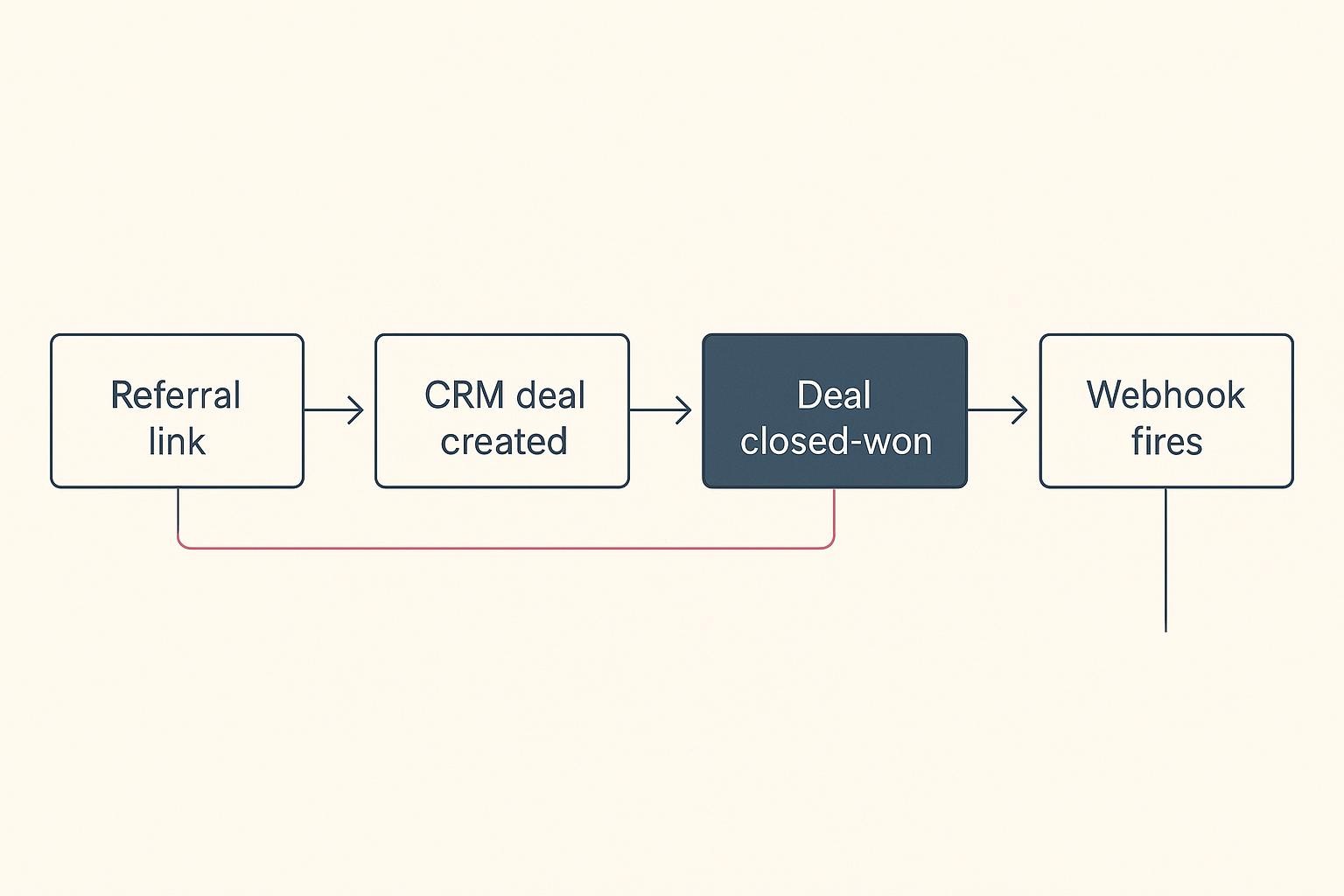
Concretely: the referral is logged the moment the link is clicked, and the reward is created immediately but held in escrow, not paid. A webhook listening for the deal's closed-won status change (documented for developers in HubSpot's deal pipeline API) triggers the escrow release. The same pattern works with Stripe if the completed-payment event, not the CRM stage, is the release condition. Stripe's webhook documentation describes how those event payloads are structured and verified. Either way, nobody is opening a spreadsheet at the end of the month to figure out who gets paid.
One more mechanical detail that home services teams skip and shouldn't: reward disclosure. If a referrer is being compensated for recommending your company, the U.S. Federal Trade Commission's Endorsement Guides require that connection be disclosed clearly, which for a referral link usually means the share flow itself states that the sender receives a reward for successful referrals. This is a one-line addition to the widget copy, not a legal review cycle, but it needs to be there.
If you're setting this up for the first time, the reward escrow, webhook, and CRM-sync pieces are documented in ReferralFlo's docs, and the product overview covers how the attribution engine, reward payouts, and analytics fit together end to end. For teams comparing platforms before committing to one, an honest side-by-side comparison is a better starting point than a features list. Booking a walkthrough is the fastest way to see the closed-won trigger configured against your own Pipedrive or HubSpot pipeline.
Frequently asked questions
Should an HVAC referral reward trigger on a signed contract or on the job being completed?
Signed contract (deal closed-won in the CRM) is the practical trigger for most programs, since it's an existing pipeline stage. Waiting for job completion and invoice payment is lower-risk but adds a delay between commitment and payout, which can dampen how the reward is perceived.
How much should a home services referral reward be relative to job value?
There's no external benchmark for this, so treat any starting number as an assumption to test. A $150 reward on a $6,000 install is 2.5% of job value; the right figure depends on install margin and what motivates a homeowner enough to share a link.
Does a referral reward for HVAC customers need a legal disclosure?
Yes. Under the FTC's Endorsement Guides, a material connection like a referral reward needs to be disclosed when someone recommends a business they're compensated for referring, typically as a short line in the share flow itself.

Referral program specialist and researcher who helps businesses turn referrals into a stable, scalable, and transparent distribution channel.
23 articles by this author →Ready to put this to work?
Watch a real program run — rewards, fraud checks and payouts — in 30 minutes.
Related reading

Why referral program benchmarks go stale fast
Referral program benchmarks shift constantly, yet popular roundup posts rarely get revised: the reward terms y…

Double-Sided Referral Program Statistics: 89% Pay Both
Double-sided referral program statistics: 35 verifiable live programs show 89% reward both referrer and friend…

Calculating Referral Revenue Finance Will Trust
A worked formula for referral revenue: sourced vs influenced, how first-touch and last-touch attribution chang…