
Motivate Referral Partners Without Raising Payouts
How to motivate referral partners without raising payouts: onboarding, behavior-triggered reminders, leaderboards, tiering and the enabler-credit model.

You don't need a bigger payout to get more referral leads out of existing partners. You need better activation mechanics. Structured onboarding, behavior-triggered reminders, visible leaderboards, and tiered status all move partner activity independent of reward size. This playbook covers each lever, then sequences them into a 90-day engagement cadence.
Why partner activity decays without a payout increase
Referral partner activity drops for structural reasons, not because the reward is too small: partners forget the program exists, they can't see whether a referral converted, or the ask feels effortful. Raising payout treats a motivation problem as a price problem. It does nothing about forgetting, invisibility, or friction, and it compresses margin on every deal that would have converted anyway.
Three decay patterns show up repeatedly in partner programs. First, an attribution gap: a partner sends a lead and never learns what happened to it, so the loop that reinforces the behavior never closes. A Growth Graph-style attribution engine that ties referral links to downstream conversions across connected CRM and billing systems closes that loop by surfacing the outcome, not just the click count. Second, silence. No nudge after the initial signup means the program fades from a partner's routine. Third, sameness: every partner gets treated identically regardless of output, so a top performer has no reason to push harder than an inactive one.
Onboarding: get partners to their first share fast
Partner onboarding should end with one concrete action: the partner generating and sharing a trackable link. A welcome email that gets read once and archived doesn't count. A referral link tied to their account from minute one, generated through a tool like ReferralFlo's link generator, makes activity measurable immediately and gives the partner visible proof the program is live.
A usable onboarding sequence has four steps: account activation, first-link generation, a disclosure prompt, and a confirmation of the first click or share. Disclosure deserves the most care. Partners promoting for compensation in the US fall under the Federal Trade Commission's endorsement rules, which require a clear statement of the material connection between partner and brand. Build that language into the onboarding flow instead of leaving it to the partner's judgment (see the FTC's Endorsement Guides). Handle it at signup and the program stays defensible without slowing anyone down.
Reminder cadence that doesn't feel like nagging
An effective reminder cadence is triggered by partner behavior, not a fixed calendar: a nudge after a stretch of inactivity, a nudge when a partner is close to a tier threshold, and a nudge when a referred lead converts. Behavior-triggered messages, sent via webhooks or a custom SDK integration, stay relevant instead of habitual. That is what decides whether a partner opens the email.
| Trigger | Mechanism | Message intent |
|---|---|---|
| 7–14 days no activity | Webhook on inactivity threshold | Re-engagement, not guilt |
| Near tier threshold | Real-time analytics check against tier rules | Push over the line |
| Referral converts | Webhook on conversion event via CRM/billing sync | Close the feedback loop |
| New reward unlocked | SDK-triggered in-product notification | Reinforce the payoff |
Real-time webhooks and a TypeScript/JS SDK let you fire these events the moment they happen, not batched into a weekly digest. That gap is the difference between a reminder that feels earned and one that feels automated.
Leaderboards and tiering: status as a non-monetary lever
Leaderboards rank partners by referral activity or attributed revenue, making relative performance visible. Tiering (Bronze/Silver/Gold-style structures) turns that ranking into a status ladder with escalating non-cash perks. Both add a social-comparison incentive alongside the cash reward, which is why they extend activity without changing payout economics.
None of this is a marketing trick; it maps to documented drivers of intrinsic motivation. Research on competence and relatedness needs, catalogued by the Center for Self-Determination Theory, explains why visible rank and progress toward a status milestone sustain effort even when the marginal cash reward stays flat. A partner chasing Gold is optimizing for something a bigger commission check doesn't touch. For the mechanics of building tiers partners want to climb — thresholds, perk design, demotion rules — see Structuring Ambassador Tiers Advocates Actually Want to Climb.
The enabler-credit model: reward the introduction itself
The enabler-credit model credits a partner for the introduction itself, separate from the final commission. Reward escrow logs the referral immediately and holds the payout pending a condition — KYC, a closed deal, a first order — while the partner sees confirmation of their contribution well before the commission clears. That early confirmation is what keeps a partner sending leads through a long B2B sales cycle, not the eventual check.
This matters most where the gap between referral and payout is wide. A partner who introduces a prospect that takes 90 days to close gets no signal for three months if the only feedback event is the payout itself. Pairing double-sided reward structures with escrow and immediate leaderboard-point crediting gives the partner two feedback loops: an instant, non-cash acknowledgment that the referral registered, and a delayed cash payout once the deal clears. For the reward-structure side (how to split value between referrer and referred without eroding margin), see How to Design a Double-Sided Referral Reward That Actually Converts.
Putting it together: a 90-day partner engagement cadence
Sequencing matters more than any single lever. A workable cadence runs onboarding on day one, a behavior-triggered nudge around day seven, leaderboard visibility by day 30, and a tier review at day 90. Each stage layers status and feedback on top of the last without touching the base payout.
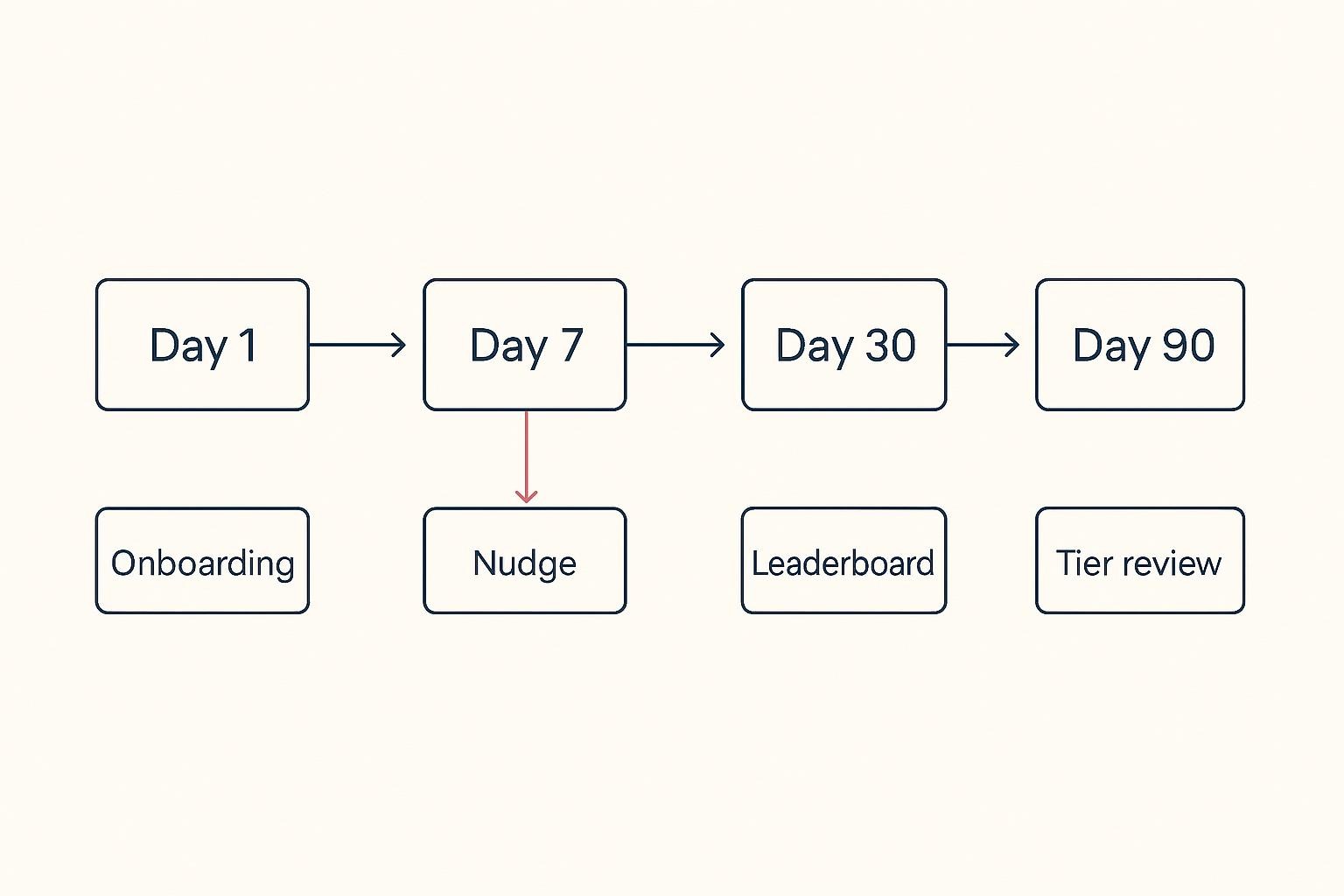
Day 1 is onboarding and the first link share. Day 7 is the first inactivity or milestone nudge if the partner hasn't engaged again. Day 30 is when leaderboard position becomes visible enough to matter; partners need enough activity in the system to see where they rank. Day 90 is the natural point for a tier review: promote or demote on the period's activity and reset the leaderboard window.
Before running this cadence at scale, model what a tiering and status program costs against a straight payout increase — the ROI calculator can rough out both scenarios from your own AOV and margin assumptions. If you're unsure whether your current setup can support behavior-triggered reminders and tier logic without custom engineering, the integrations hub and docs cover what connects out of the box. A demo is the fastest way to see reward escrow and leaderboards in a live account instead of a spec sheet.
Partner activity sometimes stalls for reasons beyond engagement mechanics: broken attribution, unclear program rules, or a reward structure partners don't understand. That's a different problem with a different fix. Why Your Referral Program Isn't Growing (And How to Fix It) walks through the diagnostic before you touch tiers or cadence.
Frequently asked questions
Does raising the referral payout reliably increase lead volume?
Not reliably. A bigger payout fixes price sensitivity, but most decay comes from forgetting, invisibility, or sharing friction, which onboarding, reminders, and status systems address directly.
How often should you send reminders to referral partners?
Trigger reminders off partner behavior: a stretch of inactivity, proximity to a tier threshold, or a referral conversion. Behavior-triggered messages stay relevant. A fixed weekly or monthly schedule becomes background noise within a month or two.
What's the difference between a leaderboard and a tier system?
A leaderboard shows relative rank at a point in time and resets periodically. A tier system (Bronze/Silver/Gold-style) locks in status earned over a longer window and typically unlocks escalating non-cash perks as a partner moves up.

Referral program specialist and researcher who helps businesses turn referrals into a stable, scalable, and transparent distribution channel.
23 articles by this author →Ready to put this to work?
Watch a real program run — rewards, fraud checks and payouts — in 30 minutes.
Related reading

Why Your Referral Program Isn't Growing (And How to Fix It)
Why your referral program isn't growing: five failure modes, from a buried share moment to unchecked fraud, wi…

The Thank You Note for a Referral That Earns a Second One
A thank you note for a referral only works when timing, channel, and wording make the referrer feel genuinely …

How to Launch an Employee Referral Program: A Step-by-Step Playbook
An employee referral program launch playbook: HR and Finance sign-off, reward structure, internal share widget…